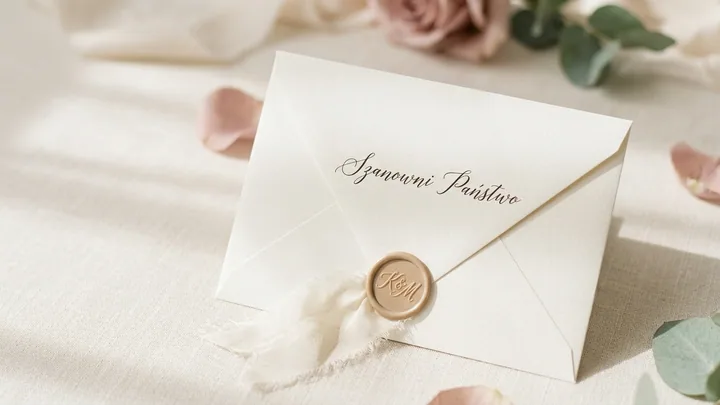
Wedding invitations
How to Address Wedding Invitations
Your wedding invitation is the first tangible piece of your wedding that lands in your guests' hands. The name on the envelope is the very first thing they'll read. A small mistake in addressing, like using the wrong title or misspelling a name, can make an otherwise beautiful invitation feel a bit careless. Worse, some guests might take it as personally as a typo in their own name — a small detail, but one that can sting.
The good news is that the rules of wedding invitation etiquette aren't as stuffy or complicated as they seem. This guide breaks down the modern conventions for addressing invitations, with clear examples and a list of common mistakes to avoid.
Why Getting the Address Right Matters
The name on the envelope and the salutation inside carry a lot of weight. Getting it right tells your guests, "We took the time to do this properly." An error, even on just one invitation out of a hundred, can signal haste and feel impersonal.
In practice, you're juggling two things at once. First, the titles and names on the envelope, which set the tone. Second, the salutation inside the invitation itself. Let's break down the most common scenarios.
Addressing Different Types of Guests: The Rules
The core principle is clarity: who, exactly, is invited? The name(s) on the envelope should leave no room for doubt. Here’s how to handle the most common situations.
Addressing a Married Couple
You have a few options here, from the very traditional to the more modern.
- Traditional (shared surname): The most formal approach addresses the husband by his title and full name, implying his wife is included.
- Envelope: Mr and Mrs John Smith
- Modern (shared surname): Many couples prefer to see both first names. This feels more personal and equal.
- Envelope: Mr John and Mrs Jane Smith
- Couple with different surnames: List each person with their full name and title. Traditionally, the person you know better is listed first.
- Envelope: Ms Jane Doe and Mr John Smith
Addressing an Unmarried Couple Living Together
The etiquette is very similar to a married couple with different surnames. List both full names on one line.
- Envelope: Ms Jane Doe and Mr John Smith
Addressing a Family with Children
If you're inviting the whole family, it's important to make that clear.
- Formal: List the parents' names first, followed by the children's names on the next line.
- Envelope: Mr and Mrs John Smith
- Annabel and Thomas
- Informal: A simpler and warmer option is to address the family as a whole.
- Envelope: The Smith Family
Important: If you are not inviting children, only list the parents' names on the envelope. This is the clearest and most polite way to indicate an adults-only event.
Addressing a Single Guest
- Invited alone: Simply use their title and full name.
- Envelope: Ms Jane Doe
- Invited with a plus-one: If you're happy for them to bring a guest of their choice, add "and Guest".
- Envelope: Mr John Smith and Guest
- Invited with a named partner: If you know the name of their partner, it's always better to use it. This is much more personal and welcoming.
- Envelope: Mr John Smith and Ms Maria Jones
Using Professional or Formal Titles (Dr., etc.)
If a guest has a professional title like Doctor, or a military rank, it should be used.
- One doctor in a couple: The person with the title is listed first.
- Envelope: Dr Jane Smith and Mr John Smith
- Both are doctors (same surname):
- Envelope: The Doctors Smith or Drs Jane and John Smith
- Both are doctors (different surnames):
- Envelope: Dr Jane Doe and Dr John Smith
Quick Reference Table: Examples at a Glance
Find your scenario and use the corresponding format.
| Guest(s) | How to Address the Envelope |
|---|---|
| Married Couple (traditional) | Mr and Mrs John Smith |
| Married Couple (modern) | Mr John and Mrs Jane Smith |
| Unmarried Couple | Ms Jane Doe and Mr John Smith |
| Family with Children | The Smith Family |
| Single Guest | Ms Jane Doe |
| Guest with a Plus-One | Mr John Smith and Guest |
| Couple with Titles | Dr Jane Smith and Mr John Smith |
Common Mistakes on Wedding Invitations
- Assuming a woman's title. Don't default to "Mrs." if you're unsure. "Ms." is a safe and respectful choice for any woman, regardless of marital status.
- Misspelling names. The most common and most easily avoided error. Double-check every single name before you write or print.
- Being vague about plus-ones. If the invitation is addressed only to "Mr John Smith," he is invited alone. If you want him to bring a guest, you must add "and Guest."
- Unclear about children. Addressing an invitation to "The Smith Family" means the children are invited. Addressing it to "Mr and Mrs Smith" means they are not. Be explicit to avoid awkward conversations later.
- Using abbreviations. For formal wedding invitations, spell everything out: "Street" instead of "St.", "Apartment" instead of "Apt.".
Digital Invitations: A Simpler Way
Here’s an argument that’s hard to ignore: most of this formal etiquette is a product of printed envelopes. With a digital wedding app, you send a personalised link directly to a person or couple. They confirm their attendance through an online RSVP form, without you needing to hand-address a hundred envelopes perfectly. Many of these potential etiquette slip-ups simply disappear.
This doesn't mean politeness goes out the window — you'll still want to write "Dear Jane and John" in your message. But the risk of a formal error on a physical envelope drops to zero. If you're considering this route, see how invitations with a QR code work. Your guest scans the code, opens your wedding website, and RSVPs in seconds.
And if you're sticking with paper, make sure the rest of your content shines. A few well-chosen wedding invitation quotes can add character that guests will remember — and might just distract them from noticing you spent hours agonising over the correct way to address the envelope.
Frequently Asked Questions (FAQ)
How do I address an invitation to a married couple?
For a traditional, formal approach, use "Mr and Mrs John Smith". For a more modern and personal touch, use "Mr John and Mrs Jane Smith". Both are perfectly acceptable.
How do I address an invitation to a couple who live together but aren't married?
Address it to both of them by their full names on a single line, for example: "Ms Jane Doe and Mr John Smith". You can list the person you know better first.
How do I make it clear that children are not invited?
Address the invitation only to the parents, e.g., "Mr and Mrs John Smith". Do not add "and Family" or the children's names. This is the standard and polite way to indicate an adults-only reception.
Should I use "and Guest" or name their partner?
If you know the partner's name, always use it. It's far more personal and welcoming than the generic "and Guest". Only use "and Guest" if you are happy for your friend to bring anyone they choose.
What's the difference between Mrs., Miss, and Ms.?
Mrs. is for a married woman. Miss is for an unmarried woman. Ms. is a neutral title that can be used for any woman, regardless of her marital status, and is often the safest and most modern choice if you are unsure.
Addressing envelopes is mainly a concern for printed stationery. If you'd rather avoid it, souveil lets you send digital invitations and a wedding website with an online RSVP form — less calligraphy, fewer mistakes, and one central place for all your replies. And if you're sticking with paper, perfect your wording with these wedding invitation quotes.