Wedding entertainment
Wedding Speeches and Toasts: Templates and Tips
You’re standing there, notes in hand, heart pounding, as the guests look on expectantly. The wedding speech is a moment dreaded by almost everyone who has to give one—and yet, it's one of the moments the couple will remember for the rest of their lives. The good news: you don't have to be a professional orator or a stand-up comedian. All you need is a simple structure, a few sincere sentences, and a little preparation. In this guide, you'll find a proven formula for a great speech, practical tips, and ready-to-use templates for the best man (we cover his full list of tasks in our article on best man duties), the maid of honour, the father of the bride, and the happy couple. We've also included a short guide on how to raise a toast that doesn't fall flat after the first sentence. If you're looking for words specifically for your parents, we have a separate guide on thanking your parents.
The Structure of a Great Wedding Speech
Every speech that captures hearts has the same skeleton: an opening, a core, and a closing. Whether you're speaking for 30 seconds or three minutes, this structure holds your guests' attention and saves you when nerves try to take over.
The Opening — Grab their attention in the first sentence
Don't start with "Right, so..." or by clearing your throat into the microphone. Your first sentence should make the guests put down their forks. A short memory, a warm joke, or a surprising statement about the couple works best. Only introduce yourself if some guests might not know you ("For those who don't know me, I'm Kate, the bride's best friend since secondary school").
The Core — One idea, not ten
The most common mistake is trying to cram your entire history with the couple into one speech. Choose one central idea: what this couple is like, why they're perfect for each other, what you love about them. Illustrate it with one specific anecdote—short, vivid, with names and a detail. Specifics always beat generalities.
The Closing — End with a wish and a toast
The last sentence is what people remember most. Close your speech with a warm wish directed at the couple, then invite the guests to raise their glasses. It's a natural transition from speech to toast—and a signal that you're handing back the spotlight.
The Best Man's Speech — Tips and Templates
The best man's speech is usually the most anticipated part of the informal proceedings. He knows the groom inside out, so guests are hoping for an anecdote—preferably funny, but never embarrassing. Remember the golden rule: make fun of the situation, not the person, and never mention ex-partners or stag do mishaps.
Stick to 2–3 minutes. Focus on one story that showcases the groom's character and end on a warm note addressed to both of them.
Template 1 — Warm with a touch of humour: "I've known Mark since we were in primary school, and over the years I've seen him in all sorts of states—but never as happy as the day he met Anna. Mark, thank you for letting me be here with you today. Anna, look after him—though I have a feeling he's the lucky one here. To the happy couple!"
Template 2 — With an anecdote: "When Mark called to say he'd met 'the one', I thought: here we go again. But this time, he wasn't talking about a new bike. This time, he was talking about Anna—and for the first time, I heard something in his voice that wasn't there before. Today, I know he was right. All the best to you both. Cheers!"
Template 3 — Short and sweet: "Mark is my best friend and the best man I know. Anna, you've got someone by your side who will never let you down—I know that from experience. I wish for you both to always be for each other what you are today. Let's raise our glasses to the bride and groom!"
The Maid of Honour's Speech — Tips and Templates
The maid of honour's speech follows the same rules as the best man's, though it often leans more towards the emotional. She usually knows the bride for years, so she has memories that can warm up the room. Moderation is key here too: one anecdote, one sincere declaration of friendship, one wish.
If you feel like emotions might get the better of you, prepare a shorter version—it's easier to finish three sentences than three minutes when your voice starts to tremble.
Template 1 — Friendship and emotion: "Anna, you've been my friend for fifteen years, and in that time I've seen you through everything. But today, in this dress, looking at Mark the way you do—you've never been more beautiful. Thank you for letting me be part of this day. Mark, you've found a treasure. To you both!"
Template 2 — With a touch of humour: "I promised Anna I wouldn't say anything embarrassing, so I'll keep it short. I'll just say that when she met Mark, she was late to meet me for coffee for the first time ever—and that's when I knew it was serious. My dears, may your love always be worth being late for. Cheers!"
Template 3 — Simple and heartfelt: "I'm not great at speeches, so I'll just say this: I'm as happy for you as if it were my own wedding. Anna, Mark—I wish you a life full of days just like this one. Let's raise a toast to the happy couple!"
The Father of the Bride's (and Parents') Speech
The father of the bride's speech is one of the most moving moments of a wedding—which is why it's worth preparing with extra care. It's a speech about pride, parental love, and seeing a daughter off into her new life. The father (or both parents) usually addresses his daughter first, then his new son-in-law, and finally all the guests.
It doesn't have to be long or grand. The most powerful words are often the simplest: how she grew up, the person she's become, and how you feel entrusting her to someone else. If both parents are speaking, divide the roles—one opens, the other closes.
Template 1 — Father to his daughter and son-in-law: "Anna, it feels like only yesterday I was walking you to your first day of school, and today I walked you down the aisle. I'm proud of you every single day. Mark, I'm entrusting you with my most precious treasure—take care of her as we have. My dears, to your life together!"
Template 2 — Parents speaking together: "As your parents, we wish for you today the same things we've given each other all these years: patience on the hard days and joy on the good ones. A home you always want to come back to. Anna, Mark—we are here for you, today and always. To the happy couple!"
Template 3 — Short and heartfelt: "It's not easy to fit twenty-something years into a few sentences, so I'll say what's most important: we are so happy you've found someone who looks at you the way Mark does. We wish you a love that grows with every year. Let's raise our glasses!"
The Couple's Speech
More and more often, the couple themselves take the floor—to thank their guests, their parents, and each other. This speech doesn't need to be a performance; it just needs to be sincere. You can speak together (one starts, the other finishes) or one after the other. This is also the perfect moment to offer thank yous to your wedding guests for their presence and help.
It's a good idea to include thanks to your parents, a brief word to each other, and an invitation to get the party started—often leading straight into the first dance.
Template 1 — A joint thank you: "Thank you all for being here with us today. Every one of you is here because you mean something to us. We want to thank our parents—without you, this day wouldn't be happening, and we wouldn't be who we are. And now, let's celebrate with us until the morning. Cheers!"
Template 2 — A word to each other: "My love, not long ago we were nervous about this day, and now we never want it to end. I promise you ordinary happiness—the everyday kind. Thank you all for celebrating it with us. To love!"
Template 3 — Short and warm: "We won't keep you long—the cake is waiting, and so is the dance floor. We just want to say: thank you. For every smile, every gift, and for every 'I do' said in your hearts along with us. Let's raise a toast to this evening!"
The Wedding Toast — Short but Sweet
A toast is not a speech—it's the finale. The best toast is one or two sentences long and ends with a clear call to action: "To the happy couple!", "Cheers!", "To love!". Guests need to know when to raise their glasses, so end with a clear signal.
A few rules to save any toast:
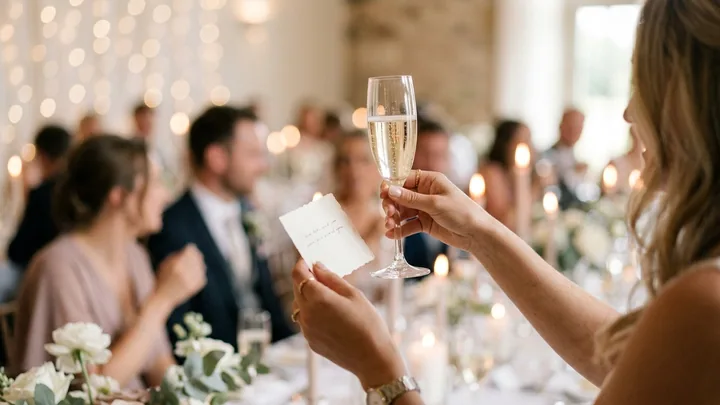
- Stand up and raise your glass — this signals to everyone that a toast is coming.
- Speak to the couple, look at the couple — not at your notes or the ceiling.
- End with a line to repeat — a short "To the happy couple!" works better than a long, complicated phrase.
- Don't drag it out — if you feel like you've been talking for a minute, it's not a toast, it's a second speech.
Ready-made lines: "To the love that officially begins today—cheers!", "May you have health, love, and joy in all the small moments of everyday life. To the happy couple!", "To Anna and Mark—and to all the days ahead of them. Cheers!". For more inspiration for words to write in a card or say aloud, check out our collection of wedding wishes.
Common Wedding Speech Mistakes
Most unsuccessful speeches happen for the same reasons—and all of them can be avoided with a little preparation.
- Too long. After three minutes, guests' attention drops sharply. It's better to finish while they still want to hear more.
- Reading word-for-word from a script. Have notes with bullet points, not the full text. That way, you can look at the couple, not a piece of paper.
- Inside jokes. An anecdote that's only funny to three people at one table leaves the rest of the room in awkward silence.
- Sensitive topics. Ex-partners, finances, politics, embarrassing party stories—these are sure-fire ways to ruin the mood.
- Improvising after a few drinks. A spontaneous toast late in the evening rarely sounds as good as the speaker thinks it does.
- No punchline. A speech that just fizzles out instead of ending with a wish and a toast loses its entire impact.
Speech Length and How to Beat the Nerves
The optimal length for a wedding speech is 1–3 minutes—about as long as it takes to read half an A4 page aloud. A toast should be just a few seconds. If there are several speeches (best man, maid of honour, parents, the couple), it's even more important for each one to be concise.
The best cure for nerves is preparation. Write your speech in advance, read it aloud a few times, and then jot down just the key points on a card—the first few words of each sentence are usually enough to guide you. Right before you speak, take a deep breath, find the couple in the crowd, and talk to them, not to the room. A shaky voice or a tear isn't a failure—it's proof that you're speaking from the heart, and guests love that.
Frequently Asked Questions (FAQ)
How long should a wedding speech be?
Ideally, 1–3 minutes, which is about half an A4 page read aloud. A toast should be kept to a few seconds. A short, well-prepared speech makes a bigger impression than a long, rambling one—guests will remember one moving thought, not ten general statements.
What should you not say in a wedding speech?
Avoid mentioning the couple's ex-partners, embarrassing stories from the stag or hen do, financial topics, politics, and jokes that only a small group will understand. The rule is simple: make fun of situations, not people, and choose memories that are heartwarming, not cringe-worthy.
Who gives speeches at a wedding and in what order?
Typically, speeches are given by the father or parents of the bride, the best man, the maid of honour, and the couple themselves. The order can vary, but a popular sequence is: parents at the start of the reception, the wedding party during the meal, and the couple at the end—often just before the first dance.
Do I have to memorise my speech?
No. It's better to have a card with bullet points than to recite the whole thing from memory under pressure. Notes with the first few words of each sentence allow you to maintain eye contact with the couple and speak naturally, while also saving you if nerves make you lose your train of thought.
How do you end a wedding speech?
End with a warm wish directed at the couple, immediately followed by a toast with a short, repeatable phrase like "To the happy couple!" or "Cheers!". This provides a natural conclusion to the speech and signals to the guests that it's time to raise their glasses.
Want to make sure the most beautiful words from your day aren't lost in the noise? With souveil, every guest can leave their wishes and memories digitally—as text, a voice note, or a short video. All the best speeches and toasts are saved in your digital guest book, which stays with you long after the wedding. And when the speeches are over, let the music begin—check out our favourite first dance songs.