Wedding planning
Best Man & Maid of Honour: Complete Guide
When a couple asks you to be their best man or maid of honour, it's one of the loveliest compliments you can receive. It means, "We trust you enough to have you by our side on one of the most important days of our lives." But after the initial wave of emotion, the question usually follows: what do I actually have to do? Is it just about standing next to them at the altar and signing a document, or is there more to it? In practice, the role is a blend of formal, organisational, and emotional duties, from looking after documents and organising the hen or stag do, to delivering a toast that guests will remember for years.
In this guide, we'll explain everything step by step: who can legally be a witness, the differences between the role at a civil and a church ceremony, what's expected of you before and on the wedding day, how to prepare a speech, and a rough idea of the costs involved. No beating around the bush, no excessive theory, just what you need to know to understand exactly what's expected of you.
Who can be a witness — the formal requirements
Before we get into the duties, let's clear up the formalities. Contrary to popular belief, the requirements for a wedding witness are very straightforward and generally similar for both civil and religious ceremonies.
Age and capacity
In the UK, a witness must be at least 16 years old. In other countries, like Ireland, the minimum age is 18. This is usually the only strict condition. Your gender, marital status, or relationship to the couple doesn't matter. A witness can be a sibling, a parent, a best friend, or a colleague from work. There's no upper age limit either: a 19-year-old can be a witness just as easily as the couple's grandparent.
A person who is unable to understand the ceremony or consciously give their consent (for example, if they are heavily under the influence of alcohol) cannot be a witness. The key is that the witness understands what they are witnessing and can confirm it with their signature. These are rare situations, but it's good to be aware of them.
Documents
On the wedding day, it's a good idea for witnesses to have a valid form of photo ID with them, like a passport or driving licence. While it's the couple's identity that is formally checked, some registrars or officials may ask to see the witnesses' ID as well. It's always better to have it with you than to be caught out.
If a witness doesn't speak the language in which the ceremony is being conducted, a certified translator may be required, especially for a civil ceremony. The witness must understand the proceedings. This is an uncommon scenario, but if it applies to you, it's worth checking with the registry office well in advance.
Civil vs. Church Ceremony — the differences for a witness
The role of a witness is similar in both types of ceremony, but a few details differ. The main points are the number of witnesses and who signs what, where.
Civil ceremony
A civil ceremony at a registry office requires two witnesses. While they are often chosen by each partner, it doesn't formally matter "whose" witness each person is. Their main task is to confirm the marriage has taken place by signing the marriage schedule or register immediately after the couple has said their vows. The witness doesn't recite any lines. They simply sit or stand near the couple and step forward to sign the document at the appropriate moment.
Church wedding
The Church of England also requires two witnesses. And, to the surprise of many, they do not need to be baptised or religious. A witness at a church wedding is not performing a religious function; their role is to legally attest that the marriage has taken place. After the ceremony, the witnesses sign the marriage register, just as they would in a civil ceremony.
In practice, the difference for you as a witness is minimal: in both cases, you stand near the couple, look after the rings, and sign a document. A church wedding might involve a bit more "choreography" (processions, standing at the altar), so it's a good idea to attend the rehearsal if the couple organises one.
Duties before the wedding
Most of the work of a best man or maid of honour happens long before the ceremony itself. This is the stage where you can really take the pressure off the couple. It's when you earn the title of "the best witness anyone could wish for."
Supporting the couple with planning
You don't have to organise the entire wedding, but your presence and help are hugely valuable. Depending on how much the couple wants to delegate, a witness often:
- accompanies them when choosing a dress or suit: an honest but kind opinion can be priceless;
- helps with last-minute tasks: packing favours for guests, writing place cards, running small errands;
- acts as a point of contact on the wedding day, fielding calls from guests, the photographer, or the venue staff so the couple isn't disturbed;
- provides emotional support: pre-wedding stress is very real, and sometimes the most important thing you can do is simply listen.
A good tip: at the beginning, ask the couple directly what they specifically need your help with. For some, the best man is a right-hand person in the organisation; for others, it's mainly about having a close friend by their side. It's better to establish this early on than to guess.
The hen and stag do
This is a classic duty: organising the hen do (for the bride) and the stag do (for the groom). The most important thing here is to talk to the person of honour: a surprise that doesn't match their personality can cause more stress than joy.
In practice, the organiser:
- decides on a budget and theme: from a relaxed spa day or dinner to a weekend away;
- gathers the group and coordinates dates (the earlier, the better; diaries fill up fast);
- ensures the event happens well in advance: not the day before the wedding, so no one shows up to the ceremony looking worse for wear.
On the wedding day — what a witness does
On the wedding day, you switch into "guardian of the peace" mode. The couple will be caught up in emotions, photos, and a hundred little things. Your role is to make sure the formalities and logistics just work.
Documents and signatures
This is your most important formal duty. Have your ID with you and be ready to sign the marriage register or schedule. It's worth knowing at what point in the ceremony this happens so you're not fumbling in your pockets for a pen at a key moment.
The rings and small emergencies
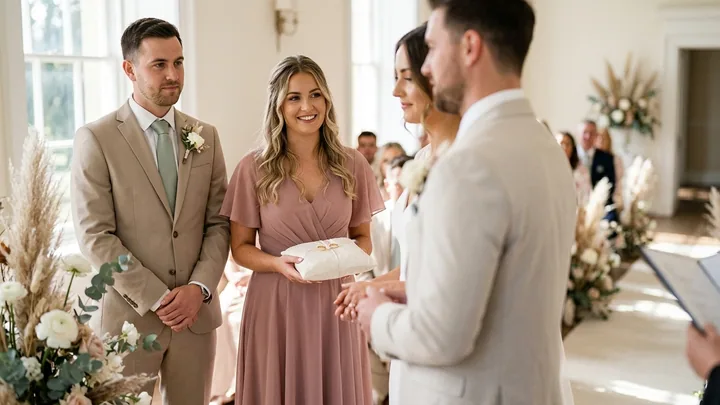
The classic image: the best man carries the wedding rings and presents them at the right time. Confirm with the couple and the person conducting the ceremony who is holding them and when they should be handed over.
Beyond that, a well-prepared witness has a small "emergency kit": tissues (tears of joy are a given), safety pins, a plaster for blisters from new shoes, a pack of chewing gum, and maybe spare tights for the bride or a needle and thread. These are the little things that can save the day when something goes wrong.
Looking after the couple
On their wedding day, it's easy for the couple to forget to eat, drink water, or rest. A witness discreetly keeps an eye on this: reminding them to have a glass of water between the photo session and entering the reception, making sure the bride has a moment to sit down, or dealing with a late guest or a lost supplier. These aren't glamorous tasks, but they are what allow the couple to simply enjoy their day.
If the couple is using digital tools to organise, the day becomes much simpler. In an app like souveil, everything (the schedule, guest list, wedding costs and formalities, and RSVP statuses) is in one place, and the couple can share their wedding website with you. This way, you know what's happening and when, without constantly having to ask.
The speech and toast
For many, this is the most stressful part of the role. The best man's speech is usually given during the reception, often as the first toast or just before the cake is cut. It doesn't have to be long or professional; it just has to be sincere.
A proven structure for a good toast looks like this:
- A brief introduction: who you are and how you know the couple (not all the guests will know you).
- An anecdote or memory: one specific story says more than ten generalisations. Ideally, something warm and humorous, but without causing embarrassment.
- A few words about them as a couple: what's beautiful about them, why they're a great match.
- Wishes and raising a toast: short and sweet, at the end, with a glass in your hand.
A few rules to avoid a disaster: stick to 2–3 minutes, practise it out loud at least once, have notes on your phone "just in case," and skip any inside jokes that only a few people will understand. If you want to polish your content, we've covered it in detail in our separate guide to wedding speeches, with ready-made structures and examples.
Gifts and costs for the witness
Being a best man or maid of honour comes with some expenses, and it's worth planning for them so nothing comes as a surprise. The most common costs are:
- Your outfit: a new dress, suit, accessories, or hairstyling is often the biggest single expense.
- The hen/stag do: you'll likely be co-organising and will need to cover your own costs (and sometimes contribute to the costs of the bride or groom, if the group agrees).
- The wedding gift: witnesses often give a slightly more personal or generous gift than other guests, but this is not an obligation. It's a matter of your means and your relationship. If you're looking for ideas, a wedding gift list can be helpful.
- Small expenses on the day: the emergency kit, flowers, transport.
The golden rule: don't get into debt to meet someone else's expectations. The couple asked you to take on this role because of your relationship, not your budget. If you feel that some of the costs are too much for you, it's better to have an honest conversation about it than to stress in silence.
Maid of Honour vs. Best Man — different expectations
Formally, the role of a male and female witness is identical. Both sign the marriage register and perform the same legal function. The differences are purely traditional and are becoming increasingly blurred.
Traditionally, the maid of honour is expected to be more involved with the bride's side of things: helping with the dress, organising the hen do, supporting her during the morning preparations, and adjusting her veil or train during the ceremony. The best man is more often expected to organise the stag do, look after the rings, and manage the day's logistics.
In reality, these divisions are flexible. The maid of honour can just as easily hold the rings, and the best man can help decorate the venue. The most important thing is to divide the tasks clearly between both witnesses and the couple, rather than assuming "it's obvious." A quick chat at the start about who is doing what will save a lot of misunderstandings down the line.
Frequently Asked Questions
Who can be a witness at a wedding?
In the UK, any person who is at least 16 years old and capable of understanding the ceremony can be a witness. The requirements are similar in most countries, though the age may vary (e.g., 18 in Ireland). Your gender, marital status, or relationship to the couple does not matter. There is no upper age limit or religious requirement.
How many witnesses are needed for a wedding?
You need two witnesses for a wedding, both for a civil ceremony at a registry office and for a church wedding. Traditionally, one is chosen by each partner, but this has no legal significance. Both witnesses confirm the marriage has taken place by signing the official marriage document.
Does a witness at a church wedding need to be a believer?
No, a witness at a church wedding does not need to be a believer or have been baptised. Their role is legal, not religious; it is to attest that the marriage has taken place. This is a common misconception. The requirements for a witness are practically the same as for a civil ceremony.
What does a witness need to have with them on the wedding day?
A witness should bring a valid form of photo ID, like a passport or driving licence, as the registrar may ask to see it. It's also wise to be in charge of the wedding rings (if that's the agreed plan) and to carry a small emergency kit: tissues, safety pins, plasters, and chewing gum. These little things can be lifesavers in key moments.
Does the best man have to give a speech?
No, a speech is not a formal requirement. It's a tradition, not a rule. However, a short toast from the best man is a much-loved part of the reception. If you decide to give one, focus on sincerity over performance: 2–3 minutes, a single heartfelt anecdote, and good wishes are all you need.
Are you a best man or maid of honour helping with the planning? The couple can share their souveil wedding website with you, complete with the day's schedule, RSVP statuses, and guest list, so you know what's happening and when, without having to ask. Souveil is one app for the whole wedding (digital invitations, automatic RSVP, seating plan, QR photo gallery, and wedding website) in a one-off package for €99 EUR, with no subscription, and guests can use it without installing anything.