Wedding planning
Wedding Rings — Styles, Metals & Prices 2026
Your wedding ring is the only thing from your entire wedding that you'll wear every day for the rest of your life. The venue, flowers, and cake will be gone the next day, but that gold band will stay on your finger for decades. That's why it deserves a bit more thought than a single visit to a jeweller's a week before the big day.
The good news is that choosing your rings doesn't have to be stressful. You just need to understand a few basics: the different styles of rings, what they're made of, how to get the right size, and what they really cost in 2026. This guide will walk you through all those decisions step by step — from the profile and metal to the engraving and aftercare.
Wedding Ring Styles
The shape of the ring — its profile and surface finish — defines its entire character. This is the first decision and a great place to start.
Classic (Court)
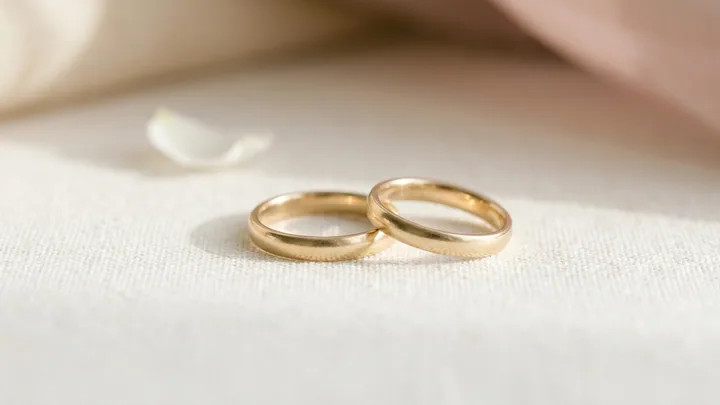
The most popular choice. A smooth, gently rounded surface, slightly convex on the outside and comfortably fitted on the inside. Classic court rings are timeless — they won't go out of fashion, they suit any style, and they're the safest bet if you don't want to experiment.
Bevelled-Edge
These have flat, angled edges that create distinct lines and catch the light in a unique way. They look a little more modern and geometric than classic rings. It's a good compromise for couples who want something with character that's still elegant and understated.
Hammered
The surface is covered with small, irregular indentations that look like hammer marks. The effect is rustic, handmade, and very individual — no two hammered rings are identical. An added bonus: the texture is great at hiding minor scratches from daily wear.
Stone-Set
Most often set with a diamond or cubic zirconia, usually in the woman's ring. The stone can be set diagonally, in a row of smaller stones, or as a single solitaire. Remember that a stone increases the price and requires a bit more care — a protruding setting can catch on things, and it's worth having a jeweller check it every so often.
Two-Tone
These combine two colours of gold — most commonly yellow with white or rose with white. They're a great way to accommodate different tastes and pair beautifully with both a white gold engagement ring and warmer-toned jewellery. It's a flexible choice that gets along with most accessories.
Metals and Gold Purity
The metal affects the colour, durability, weight, and — crucially for many couples — the price. Here are the most common options.
Yellow, White, and Rose Gold
It's all the same gold, just with different alloys:
- Yellow Gold — The classic, warm-toned, most traditional choice.
- White Gold — An alloy with metals like palladium or nickel, usually coated with rhodium for a bright white finish. The rhodium plating wears off over time, so it's a good idea to have it replated every 1–2 years.
- Rose Gold — A copper alloy gives it a warm, fashionable hue that's been popular for several years. It's also good at masking minor scratches.
Gold Purity (Carat)
The purity, or carat, tells you how much pure gold is in the alloy. The most common options are:
- 14-carat (585 fineness) — 58.5% pure gold. The most popular choice for wedding rings — it's harder, more scratch-resistant, and more affordable.
- 18-carat (750 fineness) — 75% pure gold. A richer, more intense colour, but the alloy is softer and more expensive.
For everyday wear, 14-carat gold is the practical standard. 18-carat is usually chosen for its deeper golden hue.
Platinum
A precious metal that is naturally white (so it doesn't need rhodium plating), very durable, and hypoallergenic. However, it's noticeably more expensive and heavier than gold. It's the choice for those who want a permanent white colour without the need for replating.
Palladium
Platinum's lighter and more affordable cousin, also naturally white and hypoallergenic. It's less common and harder to find, but it can be an interesting alternative for people with a nickel allergy who don't want to stretch to the price of platinum.
A note on allergies: If either of you has a reaction to jewellery, avoid cheap white gold containing nickel. Platinum, palladium, or palladium-based white gold are safer options.
How to Match Your Rings to Each Other and Your Engagement Ring
Your wedding rings don't have to be identical, but they should "go together". The most important thing is that they share a common element — the same colour of gold, a similar width, or an identical surface finish.
A few practical rules:
- Match the metal colour to the engagement ring. If the engagement ring is white gold, a white gold or platinum wedding band will create a cohesive set on one finger.
- Think about the profile. A flat-profiled band will sit more flush against an engagement ring with a high setting than a heavily domed one.
- A narrower band for her, a wider one for him is a typical arrangement, but it's just a convention — go with what feels and looks good on your hands.
- Two-tone rings are a great solution when one of you prefers yellow gold and the other prefers white.
If the engagement ring will be worn with the wedding band, take it with you to the jeweller's and try them on together.
How to Measure Your Ring Size
The wrong size is the most common problem with online orders. A wedding ring should go on with slight resistance at the knuckle and not slip off the finger on its own.
The most reliable method is to be measured by a jeweller using a set of sizing rings. If you're measuring at home:
- Wrap a strip of paper or a piece of string around the base of your finger where the ring will sit.
- Mark where it overlaps and measure the length with a ruler in millimetres — this is your finger's circumference.
- Compare the result with the jeweller's size chart.
A few tips to save you from a mistake:
- Measure in the evening — your fingers are slightly larger then than in the morning.
- Don't measure when you're cold or right after exercise.
- A wider band fits more snugly — for widths over 5–6 mm, it's worth going up half a size.
- Remember that your finger size can change with weight, pregnancy, and the time of year.
Engraving Your Wedding Rings
Engraving is the cheapest way to make your rings truly yours. Most commonly, the inside of the band is inscribed with the wedding date and your partner's initials or name. Short quotes, the coordinates of where you got engaged, or a line from your vows are also popular.
What to keep in mind:
- Decide on the text beforehand — engraving is often the last step and can extend the production time.
- Double-check the spelling. Correcting an engraving can be costly or even impossible.
- Hand-engraving has a more artisanal feel, while machine engraving is more uniform and cheaper.
- If the inside of the ring is narrow, ask the jeweller how many characters will fit — long quotes sometimes need to be shortened.
How Much Do Wedding Rings Cost in 2026
Prices depend mainly on the current price of gold, the purity, the weight (width and thickness), and any extras like stones or hand-finishing. In 2026, with precious metal prices high, the approximate ranges for a pair of wedding rings look like this:
| Style | Approximate Price for a Pair (2026) |
|---|---|
| 14ct gold, classic, narrow | €600–€1,100 |
| 14ct gold, wider or bevelled/hammered | €900–€1,700 |
| 14ct gold with diamonds | €1,200–€2,200 |
| 18ct gold | €1,400–€2,600 |
| Platinum | from €1,700 upwards |
These are guide prices — the final cost depends on the gram weight of the specific model. A wider, thicker ring means more metal, and therefore a higher price. If you're on a tight budget, you'll save the most by choosing a narrower profile in 14-carat gold.
Rings are usually one of the smaller but fixed expenses when organising a wedding. If you're putting together your full budget, check out our guides on wedding costs and formalities and how much a wedding costs so the rings don't catch you by surprise. And once the paperwork and money are sorted, the next step is figuring out how to plan a wedding — complete with a timeline and guest list.
When to Buy Your Rings and How Long They Take
The most common mistake is leaving the rings until the last minute. A realistic timeline looks like this:
- Ready-made models from a shop (after being sized) — sometimes available to collect immediately or within a few days.
- Custom-made rings — usually 3–6 weeks, and can be longer during the peak wedding season (May–September).
- Engraving and resizing — add an extra few days to two weeks.
A safe buffer is to order your rings 2–3 months before the wedding. This gives you enough time for any potential resizing and engraving without any stress. In peak season, workshops are busier, so the earlier, the better.
Caring for Your Wedding Rings
Gold and platinum are durable, but daily wear leaves its mark. A few simple habits are all it takes to keep your rings looking like new for a long time:
- Take them off when cleaning with chemicals, at the gym, and before contact with chlorine (swimming pools, cleaning products).
- Clean them in lukewarm water with a drop of mild soap and a soft brush, then dry with a soft cloth.
- White gold should be re-plated with rhodium every 1–2 years to restore its bright white shine.
- For stone-set rings, have a jeweller check the settings every so often.
- Store them separately so that harder stones from other jewellery don't scratch them.
Frequently Asked Questions
How much do wedding rings cost in 2026?
In 2026, a pair of classic wedding rings in 14-carat white or yellow gold costs approximately €600–€1,700, depending on their width and weight. Models with diamonds, in 18-carat gold, or made of platinum are more expensive, starting from around €1,200. The final price depends mainly on the amount of precious metal used.
What purity of gold is best for wedding rings?
The most popular and practical choice for wedding rings is 14-carat gold (585 fineness). The alloy is harder, more scratch-resistant, and more affordable than 18-carat gold, making it better suited for everyday wear. 18-carat gold is usually chosen for its richer, more intense colour.
How can I measure my ring size at home?
Wrap a strip of paper or string around the base of your finger, mark where it overlaps, and measure the length in millimetres. This is your finger's circumference, which you can compare with a jeweller's chart. Measure in the evening when your fingers are slightly larger, and remember that wider bands fit more snugly, so you might want to go up half a size.
How long before the wedding should we order our rings?
It's best to order your wedding rings 2–3 months before the wedding. Custom-made models usually take 3–6 weeks to create (longer in peak season), and you'll need to allow extra time for engraving and any potential resizing. Ordering early gives you a comfortable buffer for adjustments.
Do our wedding rings have to be the same?
No, your rings don't have to be identical. It's enough that they share a common element, such as the same colour of gold, a similar width, or the same finish. Often, the woman's ring is narrower and set with a stone, while the man's is wider and plain. It's also a good idea to match the metal colour to the engagement ring.
Choosing your wedding rings is one of the more enjoyable decisions in the whole planning process — but once they're sorted, the rest of the wedding awaits. Invitations, the guest list, RSVPs, the seating plan, and guest photos can take up much more time than a trip to the jeweller's. souveil brings it all together in one wedding app: digital invitations, online RSVP, a seating plan, a photo gallery with a QR code, and your own wedding website — for a one-off payment of €99 EUR, with no subscription, and your guests don't have to install a thing.