Wedding inspiration
Wedding Decorations — 2026 Trends & Ideas
Decorations are the first thing your guests see when they arrive, and the last thing they remember from the evening. It’s not about having the most flowers and candles — it’s about making the space tell your story. Good wedding decorations create a cohesive atmosphere, from the ceremony arch to the top table and the photo zone. In this guide, we'll break down decorations zone by zone, share the top wedding trends for 2026, offer ideas to match your wedding style, and look at real costs — so you know where to spend and where you can easily do it yourself.
Wedding decorations zone by zone
The easiest way to plan your wedding decorations is to divide the day into zones. Each has a different role and a different budget — not everything needs to be equally spectacular.
The Ceremony
This is the day's first "wow" moment. If you're having an outdoor wedding, the heart of the decor is an arch or arbour — wooden, metal, or made of branches, woven with flowers, dried grasses, or light fabric. Lanterns, petals, a carpet of leaves, or low floral arrangements in pots work beautifully along the aisle. In a church, a delicate decoration on the pews and an arrangement at the altar is often enough — going over the top can be unnecessary and expensive. Remember to keep it consistent: flowers from the ceremony can often be moved to the reception venue afterwards.
The Wedding Venue
The venue is the largest and most visible space. The atmosphere is primarily built with light and fabrics: festoon lights under the ceiling, drapes on the walls, or uplighting in your theme colour. Lighting has the biggest impact on how a room feels — warm, focused light can do more than dozens of flowers. Before you start buying decorations, check what the venue offers as standard. Many places already have beautiful chandeliers, wooden beams, or built-in lighting that you don't need to cover up. Also, pay attention to the entrance and welcome area, as this is where guests take their first photos. A welcome sign with your names, a floral arrangement, and good lighting will set the mood for the entire evening.
The Top Table
The top table draws the eye all evening and is the most photographed spot. It's worth investing in a taller, more impressive arrangement here than on the guest tables — a cascade of flowers, a garland of greenery flowing onto the tablecloth, or a floral hoop with a sign behind your chairs. The couple's chairs are often decorated separately (with flowers, macramé, or fabric). This is a great place for an accent that will appear in most of your official photos.
Guest Tables
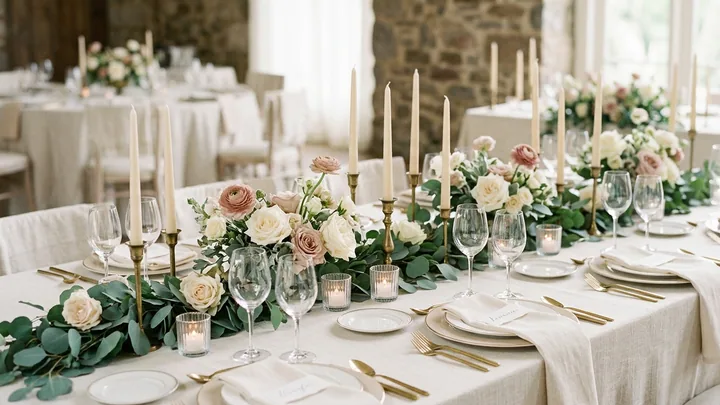
For guest tables, repetition and practicality are key. Think low arrangements or tall, slender ones (so guests can see each other), candles in lanterns, table runners, elegant tablecloths, and table numbers. The golden rule: decorations shouldn't block faces or take up all the space needed for food. A simple, repeated motif across all tables looks more cohesive than having each table different. If you want to add an interactive element, place small cards on the tables with a question for the couple or a wedding QR code to your photo gallery. It combines decoration with fun and encourages guests to grab their phones to take a picture.
Photo Zone and Backdrop
A photo zone is a decoration that "works" all evening — guests will keep coming back to it. The backdrop can be a flower wall, have a light-up sign (e.g., your initials, "love", your surname), be made of macramé, or feature a neon sign. Add some props, good lighting, and a background that looks great in phone photos. This is also the perfect place to display a QR code for your shared wedding photo gallery — guests can snap a picture and immediately upload their shots to one album.
Signage, Place Cards, and Details
The little things tie the whole story together. Place cards, the seating plan, a welcome sign, menus on the tables, signs for different zones (bar, sweet table, guest book) — all should share the same graphic style and colour scheme. This is often the cheapest yet most appreciated layer of decoration, as it's what your guests will physically hold and interact with.
2026 Wedding Trends
Trends are for inspiration, not obligation — choose what actually suits you. Here are the directions set to dominate the season.
Colours
In 2026, earthy and warm neutral palettes reign supreme: terracotta, beige, ecru, warm brown, olive, and muted green. Rich accents are also making a bold comeback — deep burgundy, bottle green, and for couples seeking elegance, navy and gold. Romantic pastel combinations (dusty rose, baby blue, lavender) are still a strong choice for spring and summer weddings.
Flowers
Fewer stiff bouquets, more natural, "undone" arrangements with plenty of greenery. Seasonal and local flowers are in vogue, as are dried pampas grass, eucalyptus, and single, statement flowers instead of dense bunches. Floral installations above the top table or dance floor remain a powerful, though costly, trend.
Candles
Candles are the cheapest way to create a luxurious atmosphere. Think clusters of candles at different heights, candles in glass hurricane lamps (to protect the flame), and long tapered candles in elegant holders. The warm light brings any venue to life after dark and looks fantastic in photos.
Neons and Light-Up Signs
Personalised LED neon signs ("better together", your initials, the date, a quote) are a strong accent for a photo backdrop or behind the top table. They add a modern touch and make a great background for photos. A cheaper, more rustic alternative: wooden or light-up marquee letters.
Dried Flowers and Pampas Grass
Dried flowers and pampas grass are a trend that combines boho aesthetics with practicality — they don't wilt, can be prepared in advance, and can be kept as a souvenir after the wedding. They work brilliantly in arches, backdrops, and as light arrangements on tables.
Wedding Decorations by Style
Your wedding style is the key that unifies every zone. Pick one direction and stick to it consistently.
Boho
Natural materials, macramé, dried flowers, pampas grass, wood, warm and earthy colours, and lots of greenery. The vibe is relaxed, "undone", and often outdoors. If this style tempts you, check out our separate guide to a boho style wedding — you'll find ready-made ideas for the whole setup.
Glamour
Elegance and opulence: gold, mirrors, crystals, tall candelabras, rich floral arrangements, and deep colours (burgundy, navy, bottle green). Lots of sparkle, shine, and light. This style is for couples who love the "wow" factor and classic luxury.
Rustic
Wood, linen, wildflowers, jam jars, jute ribbons, candles, and the warm glow of festoon lights. A cosy, natural atmosphere that suits barns, outdoor settings, and country venues. Often combined with boho elements.
Minimalism
Less is more: a muted palette (white, beige, black), simple forms, single-stem flowers, plenty of open space, and one strong accent instead of lots of small details. It's elegant, modern, and — importantly — often cheaper, as it doesn't require a large number of elements. The secret to successful minimalism is the quality of the details: beautiful paper for the invitations, elegant candle holders, and well-designed typography on the place cards. Nothing can hide behind clutter, so every element must be thoughtfully chosen.
How to Choose a Style and Not Regret It
Before you fall in love with a specific inspiration, check three things: does the style suit the venue (an industrial space clashes with delicate romanticism), the season (pastels in summer, deep tones in autumn), and you as a couple? The most beautiful weddings are those where the decorations feel like a natural extension of the couple's personality, not just a copied trend. Pick one direction, decide on 2–3 main colours, and consistently repeat them across all zones. It's cohesion, not the number of elements, that makes the biggest impression.
How much do wedding decorations cost — budget and costs
This is the question we get asked most often, so here's a straight answer. The estimated cost for wedding venue decorations in 2026 is roughly:
- Budget (DIY + basics): approx. €500–€1,000 — your own arrangements, candles, fabrics, renting basic elements.
- Mid-range (decorator + flowers): approx. €1,500–€3,000 — professional venue decoration, flowers for the tables, lighting, a backdrop.
- Premium (full styling): €4,000 and up — floral installations, a designer, extensive lighting, decoration for every zone.
The cost is mainly influenced by: the number of guests and tables, the season (flowers are more expensive out of season), the scope (just the venue, or the ceremony and photo zone too), your region, and whether you're buying or hiring items. Decorations usually make up a few to several percent of the total wedding budget. If you're planning the whole thing, check out our guide on how much a wedding costs to get the proportions right.
Where to spend and where to save? Invest in what's most visible and most photographed: the top table, the photo zone, and the venue lighting. It's easiest to save on single-use and less visible items — like decorations for the toilets or an excess of flowers on every single table.
DIY or a Decorator — Which is Better?
There's no single right answer — it depends on your time, budget, and how much you want that picture-perfect Pinterest look.
DIY (Do It Yourself) makes sense for the small details: place cards, table numbers, the seating plan, candles, simple arrangements, and zone signage. You'll save a lot of money, but at the cost of your time right before the wedding — which is usually in short supply. A good strategy is to prepare durable elements (dried flowers, stationery, macramé) that won't wilt well in advance.
A decorator is worth it where impact and logistics matter: large floral installations, lighting, setup and takedown on a tight schedule, and transport. A professional also takes the stress off your shoulders on the day — no family member has to be up a ladder hanging lights the night before the wedding. Often, a hybrid approach works best: the decorator handles the "big" things, and you take care of the personal details you want to create yourselves.
If you want guests not only to admire the decorations but also to have fun in the zones you've created, combine the styling with the evening's schedule. You'll find plenty of ideas in our post on wedding entertainment.
Frequently Asked Questions (FAQ)
How much do wedding venue decorations cost?
Estimates range from €500–€1,000 for a budget/DIY approach, through €1,500–€3,000 for a professional decorator with flowers, up to €4,000 and more for a premium package with floral installations. The final cost depends heavily on the number of tables, the season, the scope of work, and whether you buy or hire the items.
What colours are on trend for weddings in 2026?
Warm, earthy neutrals are dominant: terracotta, beige, ecru, olive, and muted green. Rich accents like burgundy and bottle green are also making a strong comeback, as is the elegant combination of navy and gold. For spring and summer weddings, pastels are still a great choice.
When should we start planning our wedding decorations?
Ideally, 8–12 months before the wedding, especially if you have your heart set on a popular decorator or a peak-season date. It's a good idea to decide on your style and colour palette early on, as this will inform your invitations, stationery, and the entire look and feel.
Is it possible to have beautiful wedding decorations on a budget?
Yes. Focus on lighting (festoon lights, candles), a single cohesive colour theme, and DIY stationery and dried flower arrangements. Instead of flowers on every table, create a few strong focal points in the most visible areas — this creates a big impact for a smaller budget.
What do guests notice the most?
The entrance and welcome area, the top table, the venue's lighting, and the photo zone. It's worth investing most of your budget in these elements, as they are seen and photographed the most throughout the evening.
A photo zone and backdrop aren't just decorations — they're where the best shots of the night happen. With souveil, every guest can upload photos from the photo booth and dance floor straight to a shared wedding photo gallery via a QR code, and you'll have them all in one place the very next morning.