Wedding planning
How to Plan a Small and Intimate Civil Wedding
More and more couples are consciously choosing to celebrate on a smaller scale. Not because they "can't afford more," but because intimate means closer — closer to the people who truly matter, and closer to how you want to remember your day. A small civil wedding isn't a "lesser version" of a big one. It's a different choice: less organising, lower costs, less stress, and often, more genuine conversations and heartfelt moments. In this guide, we'll show you how to organise a small civil wedding step-by-step — from the legalities and reception ideas to the budget, guest list, and the keepsakes that are easy to overlook with a small group.
Intimate is a Choice, Not a Compromise
Let's start with the most important thing: a small wedding is not a compromise. It's a style choice. A couple who invites twenty people instead of one hundred and twenty isn't "giving up" on a wedding — they're deciding they'd rather have an evening where they can talk to every single guest, instead of a reception where they spend half the night greeting distant relatives.
An intimate wedding gives you something a large party often can't: attention. You don't disappear into a crowd of your own guests. You have time to sit down, eat in peace, dance, and listen to speeches without being rushed. And your guests, instead of feeling like one of many, feel genuinely wanted there.
It's also a practical decision. A smaller scale means fewer things that can go wrong, less coordination on the day, and a budget that stays under control. For many couples, a small wedding is the "rich" version — rich in time, peace, and presence.
The Advantages of an Intimate Wedding
Before we get into the planning, it's worth spelling out what you gain by choosing a small wedding:
- Lower cost. The venue, catering, alcohol, and decorations scale directly with the number of guests. Fewer people means saving thousands of pounds or euros.
- More time for yourselves and your guests. With a small group, you'll manage to have a proper conversation with everyone, not just a quick hello.
- More venue flexibility. Twenty people can fit where one hundred and twenty never could — in a cosy restaurant, a garden, or a rented house.
- Less organisational stress. A shorter list of suppliers, a simpler schedule, and fewer things to keep track of.
- Easier decisions. Fewer people to please means fewer compromises and more room for what you truly want.
- Higher quality details. A budget that would be spread thin over a hundred people allows for better food, a nicer venue, and little luxuries when shared among twenty.
Civil Ceremony Legalities — In a Nutshell
The legal formalities are the same whether you're inviting twenty people or two hundred — and they're simpler than they seem. In short:
- Give notice at your local register office. You both need to attend an appointment at your local register office to declare your intent to marry. You'll need to bring proof of identity and address.
- The waiting period. You must get married within 12 months of 'giving notice'. The notice is publicly displayed in the register office for 28 days, during which time objections can be raised.
- Witnesses. You need two witnesses to be present at the ceremony to sign the marriage schedule. They are the only "mandatory" guests.
- Fees. There's a standard fee for giving notice (around £35-£50 per person in the UK). The ceremony fee itself varies depending on the venue and the day of the week. A ceremony outside the register office (e.g., at a licensed venue) will cost more.
That's the basic framework. Everything else — the date, the venue, the type of reception — is up to you. For a complete checklist of documents, costs, and timelines, check out our guide to wedding costs and legalities, where we break down every step in more detail.
Ideas for an Intimate Reception
After the ceremony, you don't have to head to a grand ballroom. A small guest list opens up many more options — here are four of the most popular.
A Restaurant Dinner
The simplest and most convenient option. You book a private room or a sectioned-off area, decide on the menu, and... that's it. You don't have to worry about catering, service, or cleaning up. For twenty people, an elegant dinner at a good restaurant can be cheaper and more stylish than a standard "per plate" wedding package at a large venue.
An Outdoor Reception
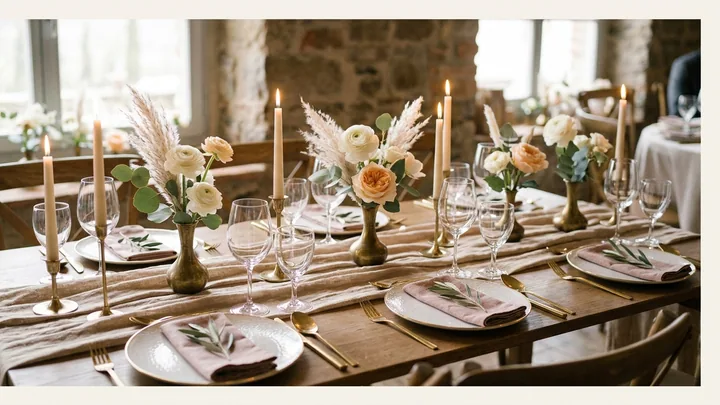
A garden, a woodland clearing, a lakeside terrace — an intimate guest count makes an outdoor event a logistical breeze. All you need is one long table, a string of fairy lights, and simple catering or a barbecue. Just remember to have a Plan B in case of rain (a marquee, a covered area, or an alternative indoor space).
A Reception at Home
The most personal option. Your own home or a weekend rental creates an atmosphere no venue can replicate. It works brilliantly for 10–20 people: cook together or hire a caterer, use your own tables, play music from a speaker, and enjoy an evening that feels nothing like a "production."
A Destination Wedding or Elopement
An increasingly popular choice: the ceremony and celebration rolled into one, in a special place — in the mountains, by the sea, or in another city. Sometimes it's just the two of you, sometimes with a handful of your nearest and dearest. This is the perfect solution for couples who prefer an experience over a party.
An Estimated Budget for a Small Wedding
The cost will depend on your location, menu, and guest count, but the ranges below provide a realistic starting point for a reception for approx. 20 guests:
| Item | Estimated Cost (for ~20 guests) |
|---|---|
| Ceremony Fees (notice & venue) | €100–€1,000 |
| Restaurant / Catering | €800–€2,500 |
| Alcohol | €200–€600 |
| Decorations & Flowers | €150–€600 |
| Photographer (a few hours) | €400–€1,000 |
| Couple's Outfits | €500–€2,000 |
| Wedding Rings | €400–€1,000 |
| Total (estimate) | approx. €2,500–€8,700 |
For comparison, a typical wedding for 100+ guests can easily cost €15,000–€25,000 or more. A small wedding isn't just about a lower final bill; it's about having more control over where your money goes. If you want to see how costs add up on a larger scale, check out our guide on how much a wedding costs — it makes it easier to appreciate the savings of an intimate format.
The Guest List — Who to Invite When Space is Limited
This is the hardest part of a small wedding: when you only have twenty spots, every invitation is a conscious choice. A simple "circles" system can help.
- Circle 1 — The Essentials. Parents, siblings, witnesses. These guests are a given.
- Circle 2 — The Closest. Grandparents, best friends, people you can't imagine the day without.
- Circle 3 — The "If There's Room" Circle. Extended family you're close to, friends you see regularly.
- Circle 4 — The Rest. Acquaintances, colleagues, people you'd invite out of politeness.
The rule is simple: start with Circle 1 and work your way down until you run out of space. A few questions to ask yourself when you're hesitating: have we spoken to this person in the last year? Would they invite us to their intimate wedding? Will we feel their absence on the day? If the answer to most of these is "no," they're probably from an outer circle.
One more thing: establish a clear rule about plus-ones and children from the start. With a small guest list, "+1" can double your numbers, so it's best to make a firm decision and apply it consistently to everyone.
How to Communicate Your Intimate Wedding Plans
A small wedding naturally raises a question for some friends: "Why wasn't I invited?" You can avoid this by communicating your plans clearly, warmly, and early.
- Be direct. In your invitation or conversation, state clearly that you're having an intimate reception for your closest family and friends. "We're having a small, intimate wedding" explains more than a long-winded justification.
- Tell people before the grapevine does. For those who might have expected an invitation, tell them personally and in advance — before they hear it from someone else.
- Don't over-explain. "We really wanted to keep it to a small group" is a complete and sufficient answer. You don't need to justify your own decision.
- Suggest another time to celebrate. For those not on the list, you could suggest meeting up after the wedding — for a meal, a coffee, or a small celebration with just a few people.
- Ensure a consistent message. A single wedding website with all the key information (date, venue, type of reception, RSVP) ensures everyone gets the same clear message, avoiding misunderstandings and guesswork. If you're sending an advance notice, a well-prepared save the date is also a great idea.
Keepsakes — Even for a Small Gathering
It's easy to think that because the wedding is small, there's "nothing much to capture." That's a mistake. The smaller the group, the more precious the memories of the day become — because you won't be repeating it with a hundred other witnesses.
- Photos. Even just a few hours with a professional photographer is enough to get a complete set of shots from the ceremony, reception, and portraits. With a small group, it's also worth giving guests an easy way to contribute their own pictures.
- A shared gallery. A QR gallery ensures that all the photos — yours and your guests' — end up in one place. A guest scans the code and uploads what they took on their phone; after the wedding, you have a complete collection, not files scattered across ten different messaging apps.
- A guest book. With twenty people, every entry will be personal, not just a polite signature. This is where the intimate scale really shines — you'll be reading these words for years to come.
- A small favour. A small guest list is also an opportunity for a more thoughtful thank-you gift — something handwritten, locally sourced, or tailored to the individual.
A small wedding doesn't mean "without a trace." It means "a trace that's truly about the people who were there."
Frequently Asked Questions (FAQ)
How much does a small civil wedding cost?
The legal formalities themselves are relatively inexpensive (e.g., giving notice in the UK is under £100 for a couple). A full intimate reception for around 20 people typically falls in the €2,500–€8,700 range, depending on the venue, menu, and your priorities. This is several times less than a typical large wedding.
How do you organise an intimate wedding step-by-step?
Start with the legalities and setting a date with your register office. Then, decide on your guest count (usually 10–30 people) and choose the type of reception: a restaurant, an outdoor event, at home, or a destination wedding. Next, use the "circles" method to create your guest list, book your venue and photographer, communicate your plans clearly, and prepare keepsakes like a photo gallery and guest book.
Can you have a civil ceremony without a reception?
Yes, absolutely. A civil ceremony is just the legal marriage ceremony at a register office or licensed venue with two witnesses. The reception is entirely optional. Many couples simply go for an intimate dinner with their closest loved ones afterwards, or celebrate just the two of them. It's a fully valid marriage, whether there's a party or not.
How many guests count as a "small wedding"?
There's no strict rule, but a small or intimate wedding is generally considered to be for up to 30-40 guests — a size where everyone can fit at one or a few tables and the couple has time to talk to everyone. Some couples go even smaller, with 10–15 guests, or choose to elope.
How do you politely tell someone they aren't invited?
The best way is to be early, personal, and direct without over-explaining. Simply say: "We're having a very small wedding with just our immediate family, so our guest list is tiny. We'd love to celebrate with you separately after the wedding." A clear and warm message prevents misunderstandings better than avoiding the topic.
Planning something intimate, but want every detail to be perfect? With souveil, you can create your wedding website with RSVP and a QR photo gallery in a single evening — it works just as beautifully for 12 guests as it does for 120. A smaller gathering doesn't mean less attention to detail.