Wedding planning
RSVP — What It Means and How to Respond
You've received a wedding invitation from friends, seen the abbreviation, and wondered: what does RSVP mean in practice? Don't worry — it's one of the most common questions asked before wedding season. This acronym hides a simple request that helps the happy couple finalise their arrangements. We show you exactly what the organisers are asking for, how to respond correctly, and why it's best not to leave it until the last minute.
RSVP — What Does It Mean?
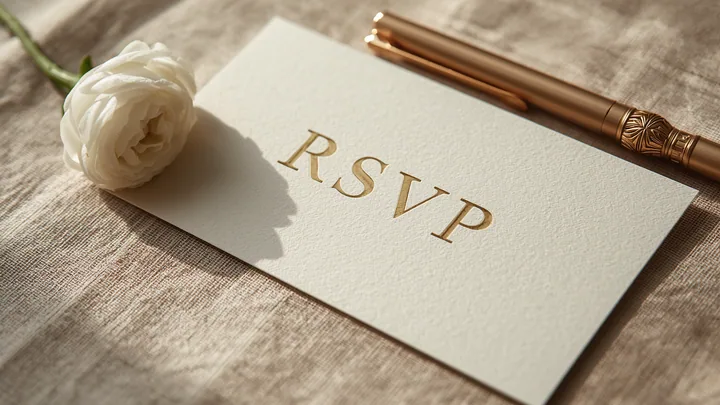
The abbreviation RSVP comes from the French phrase "répondez s'il vous plaît". Translated into English, it means: "please respond". This note at the bottom of a wedding invitation (or on a separate card in the envelope) is the couple's polite request for a clear answer on whether you'll be attending their wedding.
Today, RSVP is standard wedding etiquette. Receiving an invitation with this note signals that the organisers expect a brief and prompt declaration from you. No need for lengthy messages or beating around the bush. Whether you plan to dance until dawn or personal commitments prevent you from attending, the couple needs specific information from you.
RSVP — The Abbreviation and Its Full Form
To clear up any doubts, let's break down the abbreviation:
- R — répondez
- S.V.P. — s'il vous plaît
Together: répondez s'il vous plaît, meaning "please respond". It is pronounced with a French accent ("rep-awn-day seel voo play"), but in practice, everyone simply says "are-ess-vee-pee", and no one expects you to use a French accent. The abbreviation is written in capital letters, sometimes with full stops (R.S.V.P.), sometimes without — both forms are correct.
Is there an English equivalent? Yes — increasingly, couples are consciously moving away from the foreign abbreviation and writing directly: "Please confirm your attendance by 30th May" or "Kindly confirm your presence". This means exactly the same as RSVP, but in plain English and clear for all generations of guests.
Why Do Couples Ask for an RSVP?
If you've ever planned an event for dozens of people, you know what a logistical challenge it can be. A wedding, where over a hundred guests are invited, is far more complex. The happy couple isn't asking about your attendance just out of curiosity.
The wedding venue and catering company require a precise headcount several weeks before the event. This allows chefs to prepare the correct amount of ingredients and determine portion sizes. Another key aspect is the wedding seating plan — it's difficult to assign places, arrange place cards, and print a table plan if you don't know who's coming. And that's just the start: coordinating transport and blocking hotel rooms for out-of-town guests can cost thousands of Euros.
When couples don't receive confirmations on time, they're left planning expenses blindly. By responding promptly and clearly, you show respect for their hard work and relieve a significant amount of organisational stress.
How to Respond to an RSVP?
Your response should be submitted in the format the couple specified when they sent out the invitations. Instructions are almost always clearly stated beneath the abbreviation itself. The most common options you'll encounter today include:
- Scanning a QR code or using a provided link – the fastest and increasingly popular option. You click the link or scan the image, fill in just a few fields on the page, and you're done.
- Sending an SMS message – if the RSVP includes the couple's phone numbers, you can simply send a short text. For example: "Hi, thank you so much for the lovely invitation, we're delighted to confirm our attendance!" A quick phone call is, of course, also welcome.
- Traditional reply card – some couples still prefer a classic approach and include a special reply card with the invitation. You should fill this out by hand with a pen and send it back to the couple via traditional post.
Golden rule: if you already know that an overseas trip or another commitment will prevent you from attending, inform the couple immediately. A polite, prompt decline helps with planning just as much as confirming your attendance.
What Information Do You Usually Need to Provide in an RSVP?
Simply stating whether you'll be attending the wedding is usually just the beginning. The couple wants to ensure their guests' comfort, so the RSVP is a good place for them to gather details. When you respond, expect questions about some of the following:
- Plus-one attendance: If you've been given the option to bring a guest, the RSVP will ask you to declare whether you're bringing someone. You'll usually need to provide their full name, if you know it already.
- Special dietary requirements and any allergies: Today, it's standard practice to serve separate dishes for vegetarian wedding guests or those with severe food allergies. Provide this information in your RSVP so the kitchen staff can prepare a suitable menu for you.
- Transport and accommodation needs: If the celebration is out of town, the organisers will want to know who will use any provided coach transport and who requires a bed in a nearby hotel.
- Children attending the wedding reception: This is important to determine if parents are bringing their little ones, for whom half-sized portions of soup and separate entertainment are usually arranged.
RSVP via QR Code — How Does It Work?
A noticeable trend in the wedding industry is moving away from outdated paper processes. Environmentally conscious couples, tired of paper clutter, often offer guests a convenient escape by simply including a small QR code on the wedding invitation. Instead of printing thick cards, the entire interaction shifts to a smartphone.
From a guest's perspective, it's simple. While reading the invitation, you take out your smartphone, open the camera, and point the lens at the code. Your phone will automatically prompt you to open the form in your browser. You don't install an app, nor do you create an account. You enter your name and tick the required boxes in two minutes. For the couple, such an automatic stream of confirmations flowing into their dashboard saves many hours of work, making it an ideal feature for any wedding guest app.
When Should You Respond to an RSVP?
There's only one golden rule: respond to the invitation by the deadline specified on it. Typically, hosts set this date for about four to six weeks before the wedding ceremony.
For the couple, this final deadline isn't just a random date they've picked from the calendar to pressure guests into a quick response. It is a necessity. Dozens of orders depend on the numbers they provide — from food catering and rentals to small favours on the tables. When you need to submit the final wedding seating plan to the printer, you simply don't have the option to make changes to the chair count. Remember, the couple is already stressed enough about the wedding day itself. Don't force them to make additional calls to remind guests about basic etiquette. The default rule always applies: the sooner you sort out your RSVP, the better for everyone involved.
How to Organise RSVPs as a Couple?
If you're the organisers, RSVP is one of the first logistical tools for your wedding. Set up correctly, it will save you weeks of transcribing SMS messages into a spreadsheet. A few rules:
- Provide one clear channel for responses. The more routes (text to her, call to him, email to mum), the more chaos. The cleanest setup is a single link or a QR code on the wedding invitation leading to a form.
- Set a realistic deadline. 4–6 weeks before the wedding is standard — it gives you time for the final wedding seating plan and to provide numbers to the venue.
- Gather details straight away. Diet, plus-one, children, accommodation, transport — if you ask for this in one form, you won't have to follow up with everyone individually.
- Plan reminders. Some guests will always forget. An automated reminder after the deadline is less awkward than a phone call.
It's best to collect RSVPs where you'll later manage your guest list anyway — first the Save the Date website, then the RSVP, and finally the seating plan. If everything lives under one address, data flows from stage to stage without manual transcription, making your wedding planning app truly efficient.
Frequently Asked Questions (FAQ)
Do I still need to send an RSVP if I verbally confirmed my attendance when I received the invitation?
Yes, it's very important! Even if, in the exciting moment of receiving the envelope, you verbally confirmed your definite attendance, you should still fulfil the request expressed by the RSVP. During the period of distributing invitations, couples often have dozens of different meetings and hundreds of overlapping duties. There's a significant risk that someone might simply forget to officially add you to their big spreadsheet once they get home. Formally completing the confirmation resolves this issue.
How do I politely decline an RSVP?
A simple and honest decline before the deadline is a reason for thanks, not annoyance. Just send your notification via the requested channel — for example, fill out the form with the 'no' option, or send a brief, factual SMS. It's good practice to sincerely thank them for the invitation, state that you won't be able to attend due to family or personal reasons, and wish the couple a wonderful celebration. There's no need to explain your reasons in detail or elaborate on details.
Does the attendance confirmation also apply to the wedding ceremony itself?
On most invitations, RSVP refers only to the guest list for the reception itself (e.g., at a hired venue). The cost per person at the celebration can be significant, which is why couples strive for accurate numbers. Open ceremonies — a church wedding or a civil ceremony at a registry office — usually don't require a separate guest list.
What exactly does RSVP mean in English?
RSVP is an abbreviation of the French phrase répondez s'il vous plaît, which means "please respond". The English equivalent is simply "please confirm your attendance". Increasingly, couples are writing this directly in English — the meaning is identical, and the text is clear for all generations of guests.
Who should respond to an RSVP if the invitation is for the whole family?
One person should respond on behalf of the entire invited household, but they should provide the number and names of everyone attending — including children and any plus-one. The couple needs an exact headcount for catering, so "we'll be there" without a number of guests isn't very helpful.
Collecting RSVPs and want to have confirmations, dietary needs, and transport details in one dashboard instead of scattered SMS messages? With souveil, guests scan a QR code, confirm in 2 minutes, and you see the entire list ready for your wedding seating plan. It's the ultimate wedding RSVP app for modern couples.