Wedding entertainment
Polish Wedding Traditions & Oczepiny
A Polish wedding is more than just food, music, and dancing until dawn. It's also a collection of customs, many of which carry a significance older than most of the guests in the room. The greeting with bread and salt, the parents' blessing, the bouquet toss, the oczepiny (unveiling ceremony), and the poprawiny (the day-after party)—each of these elements has its own history and meaning, even if we don't always remember it today. This guide covers the most important Polish wedding traditions: where they come from, what they mean, and what they look like today. You'll also find out which ones are worth keeping, which you can safely skip, and how to blend tradition with a modern wedding to make your day feel both uniquely yours and rooted in something bigger.
One quick note before we begin: this article is about customs and rituals—symbolic acts that can't be boiled down to a simple contest. If you're looking for ideas for games and activities to get the dance floor going, we have a separate, detailed guide on wedding games. Here, we're focusing on the moments that hold ceremonial meaning.
The Greeting with Bread and Salt
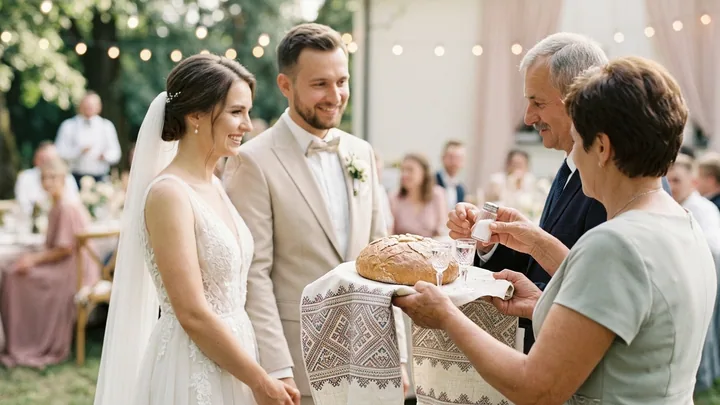
This is one of the most recognisable Polish wedding traditions. After the ceremony, the parents (or sometimes grandparents) greet the newlyweds at the entrance to the reception venue with a loaf of bread, salt, and two small glasses.
The symbolism is beautiful in its simplicity:
- Bread — So that the couple will never go hungry, a wish for prosperity and that they will always have enough to share with others.
- Salt — To remind them to overcome life's difficulties and the "bitter" moments that every marriage encounters.
- Glasses (usually with vodka, sometimes wine or water) — A toast to their good fortune. According to custom, the couple makes a toast and then throws the glasses behind them. Whoever's glass smashes into more pieces is said to be the one who will "rule the roost"—though today, this is treated with a pinch of salt.
The parents often say a short blessing or offer their best wishes. Today, the bread and salt greeting looks almost exactly as it did decades ago—it's one of those customs that has survived nearly unchanged because it's short, touching, and exceptionally photogenic.
The Threshold and First Steps into a New Home
Another custom associated with weddings is carrying the bride over the threshold. This originates from ancient beliefs that the threshold of a home was a dwelling place for ancestral spirits, and tripping over it was a bad omen. The groom would carry his new wife to protect her from this ill fortune and to symbolically introduce her to their new life together.
Today, this custom is more often performed at the couple's own home rather than the wedding venue, but it's sometimes re-enacted at the entrance to the reception as a sweet, light-hearted touch. From the same family of beliefs comes the idea that the bride shouldn't look back on her way to the altar, and that the couple shouldn't lose their wedding rings. These are small details that few people truly believe in today, but they still add a touch of ceremonial gravity to the day.
The Parents' Blessing
For many couples, the parents' blessing is the most moving moment of the entire day—often more so than the ceremony itself. Traditionally, it takes place at the bride's home, just before leaving for the church or registry office.
The couple kneels before their parents (and sometimes grandparents and godparents), who then make the sign of the cross over them, perhaps sprinkle them with holy water, and say a few words. The meaning is profound: it's a symbolic letting go of their child into an adult, independent life and an expression of parental approval for the new family being formed.
In a secular version, the blessing is often replaced by a short speech from the parents or a shared toast—without the religious elements, but with the same emotional weight. It's a good idea to let your parents know in advance that you're planning this moment, as many will want to prepare a few words. If a loved one is preparing a longer speech for the reception itself, they can find tips in our guide to wedding speeches.
The Bouquet and Bow Tie (or Garter) Toss
On the more playful, yet still ritualistic, side of things is the bouquet toss. The bride stands with her back to a group of unmarried female guests and throws her bouquet over her shoulder—tradition says that whoever catches it will be the next to marry.
The male equivalent is throwing a bow tie (or, in the past, the bride's garter) towards the bachelors. Both customs are relatively "young" for Polish traditions—in their current form, they've been largely adopted from Western weddings—but they've become firm favourites because they're dynamic and make for great photos.
Two practical tips:
- Create a fun atmosphere, not an obligation. Forcing people who'd rather stay at their table onto the dance floor spoils the fun. Make it an invitation, not a requirement.
- Prepare a "tossing bouquet". Many brides choose to throw a smaller, secondary bouquet so they can keep their main one as a memento.
If you want to treat this moment more as entertainment and build additional games around it, it's worth looking at the ideas in our article on wedding games—there, we break it down from the perspective of fun, not ritual.
Oczepiny — History and Modern Form
The oczepiny is perhaps the most quintessentially Polish of all wedding customs, and also the one that has changed the most. It's worth knowing both its historical and contemporary forms.
Where did the oczepiny come from?
Historically, the oczepiny was a rite of passage. It took place around midnight and symbolised the bride's farewell to her single life and her acceptance into the circle of married women. The central element was the removal of her veil and the placing of a cap (czepiec) on her head—hence the name oczepiny. The cap was the mark of a married woman, and the ritual was often led by older married women, sometimes accompanied by traditional songs and chants.
This was also when the bride's braid would be unplaited, symbolising the transfer of duties and the embrace of adult womanhood. It was a solemn, ceremonial moment, not purely for entertainment—closer to a ritual than to the party game it often is today.
What the oczepiny looks like today
In modern times, the oczepiny has in many places transformed into a block of games and contests centred around the veil and bow tie toss and selecting the "next couple". The traditional cap and unbraiding of the hair are seen less frequently—usually only at weddings that consciously highlight folklore, or when a couple wants to make the oczepiny a touching moment rather than just a boisterous one.
And here lies an important distinction: the oczepiny as a tradition is a rite of passage—the veil, the cap, the symbolic farewell to being a maiden. The oczepiny as a block of games is entertainment. If you're interested in the latter—the games, tasks, and ways to choose the next couple to marry—we describe it in our guide to wedding games. Here, we encourage you to treat the oczepiny as a moment with meaning: even in its modern form, it's worth preserving the moment the veil is removed, as this is what carries the significance of the entire ritual.
The First Dance
The first dance as a married couple symbolically opens the party and serves as your first public appearance as husband and wife. Traditionally, this was a waltz, but today it's increasingly a choreographed routine to a favourite song, sometimes with a surprising transition from a romantic classic to an upbeat track.
A few things to keep in mind:
- The first dance opens the dance floor—it's only after you've finished that guests feel they have "permission" to start dancing, so don't schedule it too late.
- It doesn't have to be perfect. Your guests are cheering you on, not judging your technique. A few lessons are usually enough to feel confident.
- It's often followed by a dance with parents—the bride with her father, the groom with his mother—which also has its own symbolism of saying goodbye to one's family home.
The first dance should be woven into the rhythm of the evening. We break down how to sequence the welcome, dinner, dance, cake, and oczepiny so that nothing clashes in our guide to creating a wedding day schedule.
Poprawiny — The Second Day of the Wedding
Poprawiny is the extension of the wedding into the next day, usually celebrated with the closest family and friends who stayed overnight. The tradition is deeply rooted, especially in rural areas and smaller towns where weddings could last for several days.
Today, poprawiny are much more relaxed: a shared breakfast or lunch, finishing the wedding cake and leftovers from the previous day, and calm conversations without the pressure of the "big day". It's an opportunity to unwind after all the excitement and spend quality time with people you might not have had a chance to talk to during the main reception.
Should you have a poprawiny? It's a matter of energy, budget, and how many guests are staying over. For many couples, it's the loveliest, most personal part of the weekend—free from pressure and formal schedules.
Regional Wedding Customs
Polish wedding traditions are not uniform—different regions have preserved their own distinct, often very colourful, rituals:
- Górale (Highlanders of the Podhale region) — Weddings feature live folk bands, regional costumes, traditional songs, and highlander dances; the ceremonial aspect can be exceptionally vibrant here.
- Silesia — Known for customs like "wodzenie niedźwiedzia" (leading the bear), comber (a women's party), and multi-day celebrations with strong community involvement.
- Kashubia, Greater Poland, Lublin region — Each has its own traditional songs, gate-crashing rituals, and local versions of the oczepiny.
- Wedding Gates (bramy weselne) — A popular custom in many regions where neighbours "block" the wedding procession's route. The couple or their witnesses must "buy" their passage with a symbolic offering (often alcohol).
If one of you comes from a region with strong traditions, it's worth considering weaving in at least one local element—it's a beautiful nod to your roots and a topic that always fascinates guests from other parts of the country.
Which Traditions to Keep and Which to Skip
There's no obligation to tick off every single custom. It's your wedding, so you should choose consciously. A helpful question to ask is: "Does this custom mean something to us, or are we only doing it because we feel we should?"
Traditions worth keeping (short, touching, and make for great photos):
- The greeting with bread and salt.
- The parents' blessing.
- The first dance.
- The symbolic removal of the veil (the essence of the oczepiny), even if the rest is modern.
Traditions you can safely skip or tone down if they don't feel right for you:
- Long, drawn-out blocks of games that feel forced.
- Customs that might put guests in an awkward position.
- Elements whose symbolism you don't personally connect with—a forced ritual will always feel artificial.
The golden rule is simple: keep what has meaning for you, and let go of the rest without guilt.
How to Blend Tradition with a Modern Wedding
Tradition and modernity aren't mutually exclusive—the best weddings usually combine elements of both. Here are a few tried-and-tested ways to do it:
- Keep the core, modernise the form. The bread and salt greeting can remain classic, but your stationery, music, and first dance can be completely contemporary.
- Explain the meaning to your guests. A brief word from your host explaining why you're observing a particular custom helps even younger guests understand its significance, rather than just watching passively.
- Combine ritual with technology. Digital invitations, online RSVPs, or a wedding website don't clash with the bread and salt greeting—they're simply more convenient ways to organise a day filled with traditional content.
- Make sure you capture the memories. The most ritualistic moments—the blessing, the oczepiny, the first dance—happen once and are over in a flash. It's worth having them captured by more than just your photographer.
This is where a single wedding app like souveil comes in handy: digital invitations, RSVP management, a seating plan, a wedding website, and a shared photo gallery accessible via a QR code, all in one place. For a one-off fee of €99 EUR, with no subscription, and guests don't need to install a thing. This way, photos from the bread and salt greeting, the blessing, and the oczepiny all end up in one gallery instead of being scattered across dozens of group chats.
Frequently Asked Questions
What are the most important Polish wedding traditions?
The most significant include greeting the newlyweds with bread and salt, the parents' blessing before the ceremony, the first dance, the bouquet and bow tie toss, and the oczepiny (unveiling ceremony). Poprawiny (a day-after party) and regional customs like wedding gates are also common. Each tradition carries its own symbolism, and you don't have to include them all.
What does the greeting with bread and salt mean?
The greeting with bread and salt is a wish for the newlyweds to never lack food (bread) and to be able to overcome life's hardships (salt). It's accompanied by a toast and sometimes the smashing of glasses. The parents welcome the couple with it at the entrance to the reception venue right after the ceremony—it's a short, touching, and very photogenic moment.
What is the 'oczepiny' and where did it come from?
The oczepiny is an old rite of passage where the bride's veil was removed and replaced with a cap—the mark of a married woman—symbolically bidding farewell to her single life. It took place around midnight, often involving the unbraiding of her hair and traditional songs. Today, it more often takes the form of games and contests, but it's worth preserving the moment the veil is removed.
Do we have to include all the wedding traditions?
No, no tradition is mandatory. It's your wedding, so you should choose the customs that mean something to you and skip those you'd only be doing "for the sake of it". It's best to keep the short and moving elements—like the bread and salt, the blessing, and the first dance—and opt out of anything that might make you or your guests feel awkward.
How can we blend tradition with a modern wedding?
The best approach is to keep the core of the ritual but modernise its presentation—the style, music, and organisation. Explain the meaning of different customs to your guests, combine tradition with convenient tools (like digital invitations, online RSVP, and a QR photo gallery), and make sure the most important moments are captured. Tradition and modernity complement each other beautifully when one doesn't try to cancel out the other.
Blending tradition with a modern wedding? With souveil, you can collect guest photos from every moment—from the bread and salt greeting to the oczepiny—in a single gallery accessible via a QR code. It's a one-off fee, with no subscription and no app for guests to install, ensuring the most beautiful ceremonial moments stay with you long after the wedding is over.